Not sure what's on your skin? Scan it.
Upload a photo and SpotCheck's deep-learning model gives you a quick read on whether it looks more like dermatitis (inflammation) or dermatophytosis (a fungal infection) — then helps you learn what each group means.
This is not a medical diagnosis. SpotCheck names a group of conditions, not a specific disease, and it always answers with one of its two classes even when the photo is neither. It is a supportive tool, not a doctor. See a dermatologist or healthcare provider to confirm any skin condition and get treatment.
Three steps, a few seconds
Everything runs on a convolutional neural network (CNN) trained from scratch to tell these two look-alike groups of conditions apart.
Upload
Add a clear, well-lit photo of the affected skin. The image never leaves the model's own pipeline.
Analyze
The image is resized and normalized, then the CNN reads its visual patterns and scores each class.
Learn
You get a confidence read for dermatitis vs dermatophytosis, plus a jump into plain-language education on each.
Send it only what it was built for. The model knows two answers and nothing else — it cannot reply "this is neither". Give it a photo of healthy skin, a different skin condition, or anything that isn't a rash at all, and it will still pick one of the two and put a confidence figure next to it.
So please upload only a photo of a rash you think might be dermatitis or dermatophytosis. For anything outside that, the answer is not a weak result — it is a meaningless one.
Understand both groups
Dermatitis and dermatophytosis are not two diseases — they are two families of skin conditions. They share redness, itch and scaling, which is exactly why they're so easy to confuse. Here's what sets them apart.
Each family has many members. Dermatitis covers everything from atopic and contact dermatitis to seborrheic and stasis dermatitis; dermatophytosis covers tinea of the scalp, body, face, groin, hands, feet and nails.
Rather than write a guide for every member, SpotCheck's education pages take the best-known example from each family — eczema for dermatitis and ringworm for dermatophytosis — and explain it in depth. What you learn there is the clearest way into the family as a whole.
Eczema (Dermatitis)
The best-known member of the dermatitis family — skin inflammation that is not caused by an infection. Eczema leaves skin dry, itchy and inflamed when its barrier is disrupted by triggers.
Read the guide →Ringworm (Dermatophytosis)
The best-known member of the dermatophytosis family — fungal infections of skin, hair and nails caused by dermatophytes. Ringworm forms a ring-shaped, scaly-bordered rash treated with antifungals.
Read the guide →Eczema (Dermatitis)
Dermatitis is skin inflammation that is not caused by an infection. It covers a whole family of conditions that share the same look: redness, swelling, small inflamed bumps or blisters, scaling, crusting and thickened skin, usually with itch, pain or a burning feeling.
What this guide covers. SpotCheck's model recognises the dermatitis family as a whole — atopic, irritant contact, allergic contact, photoallergic, protein contact, phototoxic, radiation, seborrheic, stasis, autoimmune and deficiency dermatitis all belong to it.
Writing a separate guide for each one would bury the thing you actually need. So this page goes deep on eczema, the family's best-known and most-studied member, whose dry, itchy, inflamed skin is the picture most people already have in mind when they think of dermatitis.
Overview
⌄What is eczema?
Eczema is a condition that causes your skin to become dry, itchy and bumpy. It weakens your skin's barrier function, which helps your skin retain moisture and protects your body from outside elements. Eczema is a type of dermatitis, a group of conditions that cause skin inflammation.
What are the types of eczema?
Each type has unique triggers that can affect your skin's barrier function:
- Atopic dermatitis
- A chronic type that discolours skin and brings itchy rashes. It usually starts in childhood and can keep flaring in adulthood. There's no cure, but creams and medication manage it.
- Contact dermatitis
- A rash where your skin met something you're allergic to or something that irritated it. It can swell, itch and feel uncomfortable — avoiding the trigger keeps it from returning.
- Dyshidrotic eczema
- Tiny itchy blisters on the hands and feet that can crack and peel as they heal. The cause isn't known; allergies, stress and frequently damp or sweaty skin may trigger it. Managed with at-home care and prescription medicine.
- Neurodermatitis
- Also called lichen simplex chronicus. Constant itching and scratching turn skin thick, rough and leathery, and the itch can be intense at night or under stress. Treatment breaks the itch–scratch cycle so skin can heal.
- Nummular eczema
- A chronic type that raises round, coin-shaped spots. They often itch, sometimes ooze clear fluid and may crust over. It usually responds well to treatment, though episodes can return.
- Seborrheic dermatitis
- Common, and makes skin itchy, flaky and scaly — especially on the scalp and face. It isn't contagious and comes and goes through life; medicated creams and shampoos keep it managed.
It's possible to have more than one type of eczema at the same time.
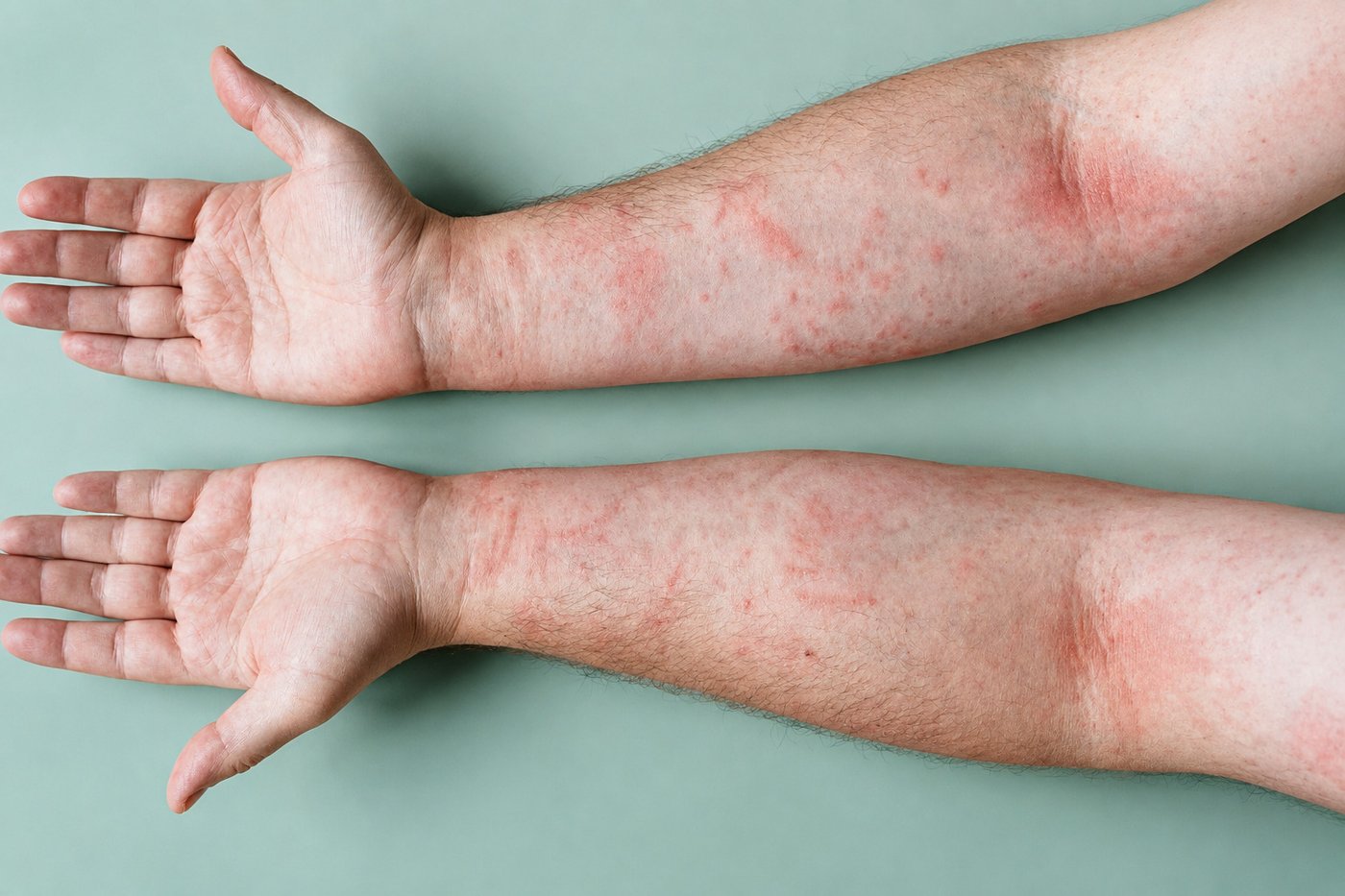
Who does eczema affect?
Eczema can affect anyone at any age. Symptoms usually appear during childhood and last into adulthood. Your risk is higher with a family history or diagnosis of dermatitis, allergies, hay fever or asthma.
How common is eczema?
Eczema is common and affects more than 31 million Americans. Infants are prone to it — 10% to 20% will have it — but nearly half of infants diagnosed outgrow it or improve significantly as they get older.
Symptoms and Causes
⌄What are the symptoms of eczema?
- Dry skin
- Itchy skin
- Skin rash
- Bumps on your skin
- Thick, leathery patches of skin
- Flaky, scaly or crusty skin
- Swelling
What does an eczema rash look like?
Eczema can look different on each person. On darker skin tones a rash can be purple, brown or gray; on lighter skin tones it can look pink, red or purple.
Where do symptoms appear?
Symptoms can appear anywhere. The most common spots are the hands, neck, elbows, ankles, knees, feet, face (especially cheeks), in and around the ears, and lips. Less commonly, it can appear on the nipples, breasts, vulva and penis.
Does eczema hurt?
Eczema doesn't usually cause pain. Scratching can break the skin and create a painful sore. Some types, like contact dermatitis, cause a burning sensation and discomfort.
What causes eczema?
Your immune system: it overreacts to small irritants or allergens, treating them as invaders and creating inflammation, which causes symptoms.
Your genes: risk is higher with a family history of eczema, dermatitis, asthma, hay fever or allergies, or a genetic mutation affecting the skin barrier.
Your environment: smoke, air pollutants, harsh soaps, wool, some skin-care products and low humidity can all irritate skin; heat and high humidity worsen itch.
Emotional triggers: high stress, anxiety or depression can bring on more frequent flare-ups.
What triggers a flare-up?
Triggers differ per person, but common ones include dry weather, certain fabrics, makeup or skin-care products, smoke and pollutants, soaps and detergents, stress, and touching something you're allergic to.
Do certain foods trigger eczema?
The link is unclear. If you have a food allergy (common ones: peanuts, dairy, eggs), that food may worsen symptoms. If you don't have a food allergy, no foods will cause or worsen your eczema.
Is it autoimmune? Is it contagious?
Eczema can make the immune system overreact but isn't classified as autoimmune. It is not contagious — you can't spread it through contact.
Diagnosis and Tests
⌄How is eczema diagnosed?
A healthcare provider diagnoses eczema after a physical exam of your skin. Most people are diagnosed as children, but it can happen at any age. Because symptoms resemble other conditions, tests may be used to rule those out and confirm the diagnosis, such as an allergy test, blood tests, or a skin biopsy to distinguish one type of dermatitis from another.
Questions a provider might ask
- Where do you have symptoms on your body?
- Did you use any products to treat your skin?
- Do you have conditions like allergies or asthma?
- Is there a history of eczema in your family?
- How long have you had symptoms?
- Do you take hot showers?
- Does anything make symptoms worse (certain soaps or detergents)?
- Do symptoms affect your sleep or daily activities?
Who diagnoses eczema?
A primary care provider may refer you to a dermatologist — a specialist in skin conditions — to diagnose and treat your eczema.
Management and Treatment
⌄How do I get rid of eczema?
Treatment is unique to you and your triggers. It may include:
- Using gentle, sensitive-skin moisturizers throughout the day; apply when skin is damp after a bath or shower
- Topical medications such as topical steroids, as advised by your provider
- Oral medications like anti-inflammatories, antihistamines or corticosteroids to reduce itch and swelling
- Immunosuppressant drugs to help regulate the immune system
- Light therapy to improve the skin's appearance
- Avoiding triggers that cause flare-ups
How do you treat childhood eczema?
- Give short, warm baths instead of long, hot ones
- Moisturize several times daily (for infants, with each diaper change helps a lot)
- Keep room temperature and humidity steady
- Dress your child in cotton; avoid wool, silk and synthetics like polyester
- Use sensitive-skin or unscented laundry detergent
- Help them avoid rubbing or scratching
What type of moisturizer treats eczema?
Choose products that are hypoallergenic, fragrance- and dye-free; gentle or for sensitive skin; contain petroleum jelly or mineral oil; are free of preservatives or stabilizers; and include lipids and ceramides to improve the barrier. It may take trial and error to find the right one.
How do I manage symptoms?
You may not control genetic causes, but you can influence your environment and stress. Figure out what triggers or worsens your eczema and avoid it. The goal is to reduce itching and discomfort and prevent infection and further flare-ups.
How soon will I feel better?
It can take several weeks for skin to clear completely. Prescribed medications speed things up. If symptoms worsen or don't clear after a few weeks, contact your provider.
Are there complications?
Weeping eczema causes fluid-filled blisters. Infected eczema occurs when bacteria, fungus or a virus breaks through the skin. Warning signs include fever and chills, clear-to-yellow fluid leaking from blisters, and pain and swelling.
Outlook / Prognosis
⌄What can I expect?
Eczema and other dermatitis aren't harmful to the rest of your body and the condition isn't deadly. Nearly half of children with eczema outgrow it or improve by puberty; others have some form of it throughout life. For adults, it can be well managed with a good skin-care routine.
How long does eczema last?
Eczema can be lifelong — starting in infancy and continuing into adulthood. You can manage symptoms with at-home remedies, over-the-counter medications and prescriptions.
Is there a cure?
No. There are effective treatments, but none eliminate symptoms 100% of the time. Eczema is chronic — it can go away and come back unexpectedly — and treatments are very effective at reducing itchy, dry skin.
Prevention
⌄How can I prevent flare-ups?
- Moisturize regularly, sealing in moisture right after a bath or shower
- Bathe or shower with warm, not hot, water
- Stay hydrated — aim for at least eight glasses of water a day
- Wear loose cotton and natural materials; wash new clothing first; avoid wool and synthetics
- Manage stress and emotional triggers; seek professional support if needed
- Use a humidifier if dry air dries your skin
- Avoid irritants and allergens
Living With
⌄How do I take care of myself?
Living with eczema can be challenging. Times when it disappears are called "remission"; times when symptoms appear or worsen are "flare-ups." The goal of treatment is to prevent flare-ups — avoid triggers, moisturize, take your medicine and follow your provider's instructions.
When should I see my provider?
- You experience symptoms of eczema
- Symptoms get worse after treatment
- Symptoms don't go away a few weeks after treatment
- You get an infection, have a fever or experience severe pain
Questions to ask your provider
- If it isn't eczema, what other skin condition might it be?
- Is there a specific moisturizer brand you recommend?
- Are there side effects to the treatment?
- How often should I see a dermatologist?
- What soaps, lotions or makeup should I avoid?
- How can I care for my skin at home?
Additional Common Questions
⌄Does the weather make eczema worse?
Yes. Certain temperatures and weather patterns can affect your skin. Low humidity (dry air) in winter can dry it out, while humidity from high heat makes you sweat, which can make itchiness worse.
Ringworm (Dermatophytosis)
Dermatophytosis — also called tinea — is a fungal infection of the skin, hair and nails caused by a group of fungi called dermatophytes, which can break down keratin and so live in the tissue that contains it. On the body it typically forms ring-shaped, scaly, red patches whose edge is more inflamed than the centre.
What this guide covers. SpotCheck's model recognises the dermatophytosis family as a whole. Its members are named for the body site they infect — tinea capitis (scalp), corporis (body), faciei (face), cruris (groin), manuum (hands), pedis (feet) and onychomycosis (nails).
Rather than a thin guide for each site, this page goes deep on ringworm — tinea corporis, the family's best-known member — because its ring-shaped, scaly-bordered rash is the pattern that gives the whole group its everyday name.
Overview
⌄What is ringworm?
A fungus — not a worm — causes ringworm. Fungi thrive in warm, humid areas like locker rooms and public showers. This common, contagious infection gets its name from the red, itchy, ring-shaped plaque it forms, and it spreads easily through close contact with an infected person, animal or object. Ringworm on the body is called tinea corporis, affecting the arms, legs, torso and face. It's treated with antifungal medication, over the counter or by prescription.
Types of ringworm
- Athlete's foot (tinea pedis): itchy, burning rash between the toes and on the soles; skin may become scaly, cracked or blistered.
- Jock itch (tinea cruris): red, itchy rash in the groin, upper thighs or rectum.
- Scalp ringworm (tinea capitis): scaly, red, itchy bald spots that can grow and become permanent if untreated.
- Hands (tinea manuum): dry, cracked palms and ring-like patches.
- Beard (tinea barbae): patches on the neck, chin and cheeks that may crust or fill with pus.
- Nails (tinea unguium / onychomycosis): thick, discolored, deformed nails.
What does ringworm look like?
It typically begins as a flat, discolored patch — red in lighter complexions, brown in darker ones — with a ring-like, circular shape and a raised, scaly border.
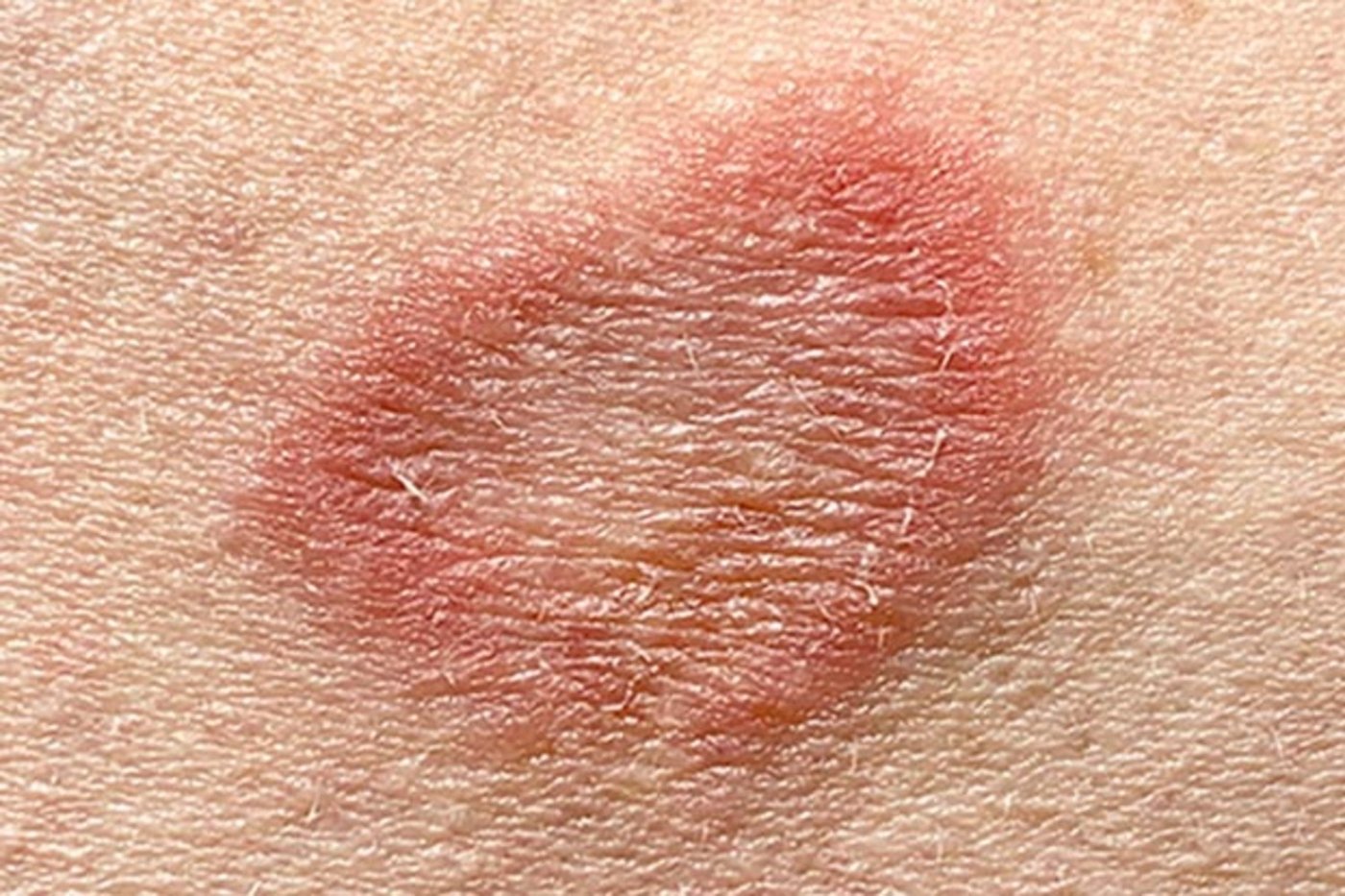
Who gets ringworm?
It affects all ages. You're more at risk if you have a weakened immune system or an autoimmune disease like lupus, play high-contact sports such as wrestling, sweat excessively, use public locker rooms or showers, or work closely with animals that might have ringworm.
How common is it?
Ringworm is contagious and extremely common — it can affect 20% to 25% of the world's population at any given time.
Symptoms and Causes
⌄What are the signs of ringworm?
Signs typically appear four to 14 days after your skin contacts the fungus:
- Circular, ring-shaped scales or plaques
- Flat patches with a raised, round border
- Itchy skin
- Hair loss or bald spots in the affected area
What causes ringworm?
Despite its name, a fungus causes it. This fungus naturally lives on your skin, hair and nails, but when its environment gets hot and damp it starts growing uncontrollably. You can get infected whenever your skin contacts the ringworm fungus on someone else's skin.
How contagious is it?
Ringworm is contagious. It can live on skin, surfaces and in soil. It mainly spreads through:
- Skin-to-skin contact with someone who has ringworm
- Contact with an infected dog, cat or other animal (pets or livestock)
- Contact with a contaminated surface, like a locker-room floor or sweaty gym clothes
- Sharing objects such as a brush, towel or bedding
- Contaminated soil
Diagnosis and Tests
⌄How is ringworm diagnosed?
Your healthcare provider can diagnose ringworm by looking at your skin and assessing your symptoms. They may scrape the area to examine the skin cells under a microscope — examining the scales typically confirms ringworm.
Management and Treatment
⌄How is ringworm treated?
Several over-the-counter and prescription antifungal medications treat ringworm, in forms like creams, gels or powders. More widespread ringworm can be treated with oral antifungal medication.
Antifungal creams and powders
OTC creams, gels or powders typically work well, including clotrimazole (Lotrimin®, Mycelex®), miconazole (Desenex®), terbinafine (Lamisil AT®) and tolnaftate (Tinactin®). If symptoms worsen or don't clear after two weeks, you may need an oral prescription.
Oral medication
A provider may prescribe oral antifungals for scalp ringworm or when many parts of the body are affected, usually for one to three months — for example fluconazole (Diflucan®), griseofulvin (Griasctin®), itraconazole (Sporanox®) and terbinafine (Lamisil®).
Antifungal shampoo
Shampoo such as ketoconazole (Nizoral A-D®) may stop scalp ringworm from spreading. It won't cure it — you also need a prescribed oral antifungal — and unaffected family members may benefit from using it too.
Home remedies
Remedies like apple cider vinegar or tea tree oil have little to no benefit; apple cider vinegar may cause open sores or inflammation. Your home may also need treatment — the fungus can live on surfaces for months, so use disinfectant sprays or bleach and wash clothes, sheets and towels in hot water and detergent.
Steroid creams
Corticosteroid creams may reduce inflammation but shouldn't be used to treat ringworm — in fact, they may worsen the infection.
What cures ringworm?
Mild cases clear within a few weeks; more serious infections may need six to 12 weeks. To promote healing: keep the area clean and dry, apply antifungal products for the entire treatment period, and avoid touching the area (wash your hands before touching other areas).
Does ringworm go away by itself?
It can, but that's uncommon — and while it's present on your skin, you're still contagious to others.
Outlook / Prognosis
⌄Can ringworm come back?
Yes. Ringworm will go away if treated appropriately, so follow your provider's plan until the infection clears completely. If you stop treatment or end it too soon, the infection can come back.
What are the complications?
Don't use anti-itch creams containing corticosteroids — they weaken the skin's defenses and can let the infection spread over larger areas. Rarely, the fungus goes deeper into the skin, making it harder to treat. Scalp ringworm can lead to a painful inflammation called kerion, with crusty, pus-filled sores, hair loss and scarring.
Prevention
⌄How can I prevent ringworm?
Ringworm thrives in damp, warm areas and can live on towels, clothes, sheets and surfaces for months. To prevent it:
- Change socks and underwear daily, or more often if damp or soiled
- Shower immediately after contact sports or exercise
- Wear sandals or shower shoes at pools and in public locker rooms and showers
- Dry your skin thoroughly after showering, especially between the toes
- Don't share towels, washcloths, sheets, clothes or combs
- Wash clothes, athletic gear, sheets and towels in hot water and detergent
- Disinfect surfaces with bleach or sprays
- Treat pets for ringworm if they're infected, and wash your hands after contact with animals
A weak immune system or a damp, warm climate increases your risk.
Living With
⌄When should I call the doctor?
Call your provider if the infection appears on your scalp, looks infected (redness and swelling), occurs during pregnancy, spreads to other areas, or doesn't improve after using OTC antifungal medication as directed.
Questions to ask your doctor
- How did I get ringworm?
- How long is ringworm contagious?
- Should I (or my child) stay home from work/school until it's gone?
- How do I prevent it spreading to other parts of my body — or to other people?
- What's the best treatment? Should I avoid any medications?
- How can I keep from getting it again?
- How can I tell if my pet has ringworm?
- Should I watch for signs of complications?
Additional Common Questions
⌄Is ringworm an actual worm?
No. It's a fungal infection that gets its name from its ring-like border.
How does ringworm affect pregnancy?
The fungus won't affect your pregnancy, but check with your provider before using OTC antifungal creams or powders. Oral antifungals appear safe in pregnancy — your care provider can discuss risks and benefits.
Can you get ringworm from dogs or cats?
Yes — from dogs, cats and other animals like cows, goats or horses. Wash your hands after petting animals, and if a pet has ringworm, disinfect its bedding and clean surfaces it has visited.
How is ringworm different from eczema?
Both cause itchy, red skin, but unlike ringworm, eczema isn't contagious and doesn't spread from one area to another. Ringworm has a unique, ring-like appearance. Contact a provider for an appropriate diagnosis.
A CNN trained from scratch to tell dermatitis and dermatophytosis apart
SpotCheck is powered by a convolutional neural network (CNN) that was built and trained from scratch — no pre-trained model was reused. Because inflamed skin and fungal infections share redness, itch and scaling, the model learns the subtle visual patterns that separate the two families. Here's how it was built, from data to deployment.
- Residual CNN
- from scratch, no transfer learning
- 747,713
- parameters · 8.68 MB
- 336 × 224
- input canvas, 3:2
- 150 epochs
- weights from epoch 134
Introduction
⌄Dermatitis (non-infectious skin inflammation) and dermatophytosis (fungal infection by dermatophytes) have similar clinical appearances — redness, itching, scaly skin — which makes them hard to tell apart by eye, especially early on. A mix-up matters: treating dermatophytosis with steroids as if it were dermatitis can push it into tinea incognito, where the infection loses its usual signs and becomes even harder to recognise.
SpotCheck tackles this as a binary image classification problem: dermatitis versus dermatophytosis. The model is a Convolutional Neural Network (CNN) trained entirely from scratch — no transfer learning, no pre-trained backbone. Development followed the CRISP-DM pipeline: data understanding, preparation, modeling, evaluation and deployment.
Dataset
⌄Images come from a DermNet collection assembled via Kaggle: 9,987 images in total — 5,490 dermatitis and 4,497 dermatophytosis. Every file opened cleanly, so no image was lost to corruption.
Cleaning was aggressive, because duplicates spread across source uploads inflate scores without adding information. Exact duplicates were found by content hashing and near-duplicates by perceptual hashing, with connected copies grouped so each chain of look-alikes keeps only one representative. A further pass removed images showing drug eruption, a reaction that belongs to neither target family.
Two thirds of the raw collection was discarded. That looks drastic, but a duplicate photo appearing in both the training and test sets would quietly inflate every score that follows — so removing them is what makes the numbers in Section 06 mean anything.
The remaining 3,049 images were split 70 / 15 / 15, stratified per class so both families keep the same proportions everywhere:
The ratio holds at 1.25 : 1 in all three splits, so the validation and test scores are measured on the same class mix the model trained on.
Preparation
⌄Every image was standardized to three-channel RGB and placed on a 336×224 canvas. That shape is not arbitrary: measured across the collection, the median image has a long-to-short side ratio of 1.51, so a 3:2 canvas (ratio 1.50) wastes the least space on padding.
Step 2 is the one that is easy to miss. Without it a portrait photo would be shrunk to fit the canvas height and end up as a narrow strip between two wide black bars — far less skin for the model to read than it saw during training.
The black bands above are drawn thicker than they usually are, so that they show up at all. On a real photo they are hardly there: the median image in the collection has an aspect ratio of 1.51 against the canvas's 1.50, which leaves a band well under 1% of the height. That near-perfect fit is the whole reason the canvas is 3:2 — 80% of the collection sits between ratios 1.47 and 1.53.
To help the model generalize, the training set received augmentation applied per batch after normalization: horizontal and vertical flips (each with probability 0.5), random zoom between 0.7 and 1.0, and brightness shifts of ±0.2. Validation and test images were only transformed and normalized — no augmentation — so evaluation reflects real, unaltered data.
Model architecture
⌄The network — Residual_CNN_Dermatitis_Dermatophytosis — is built with the Keras Functional API. Two plain convolutional blocks are followed by two residual blocks, where a skip connection carries the earlier tensor forward and adds it back after the convolutions. That shortcut is what lets gradients reach the early layers of a deep stack. A SeparableConv2D in the last block keeps the parameter count down.
The green rails on the right are the skip connections. Each carries the tensor from before the block through a 1×1 convolution and pooling — just enough to match the shape — and adds it back at the +. SpatialDropout2D (0.15) sits inside the convolutional body; ordinary dropout (0.3) follows each dense layer.
| Parameters | Count | Share |
|---|---|---|
| Convolutional body | 648,896 | 86.8% |
| Classification head | 98,817 | 13.2% |
| Total | 747,713 | 100% |
At roughly three quarters of a million parameters the model is compact — light enough to load and run inside a web app on an ordinary CPU.
Training strategy
⌄The model was trained with the AdamW optimizer and a cosine decay learning-rate schedule with warmup: the learning rate ramps gently from 1e-5 up to 5e-4 over the first 10 epochs, then decays smoothly along a cosine curve toward zero. Weight decay is 1e-4, excluding normalization parameters and biases. The loss is binary cross-entropy with label smoothing (0.05), which discourages the model from becoming overconfident and helps it generalize.
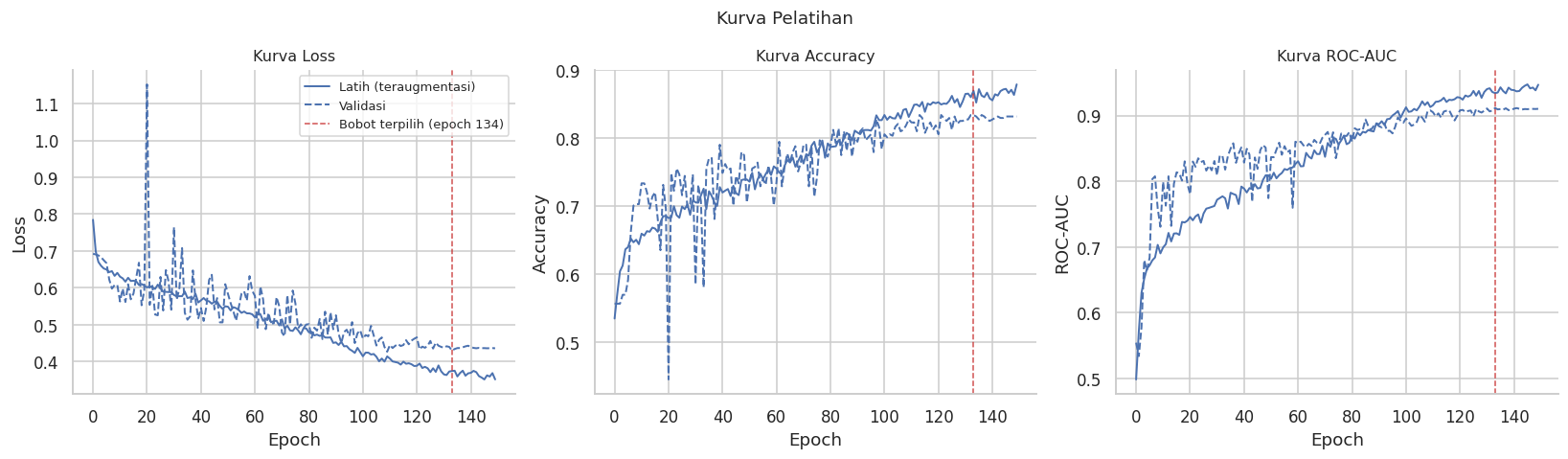
Training ran the full 150 epochs — there was no early stopping. Instead a checkpoint kept the weights from whichever epoch scored highest on validation ROC-AUC, a threshold-independent criterion. That turned out to be epoch 134. All three splits were then re-measured without augmentation, so the numbers are directly comparable:
| Split | Loss | Accuracy | ROC-AUC |
|---|---|---|---|
| Train | 0.3065 | 89.83% | 96.87% |
| Validation | 0.4297 | 83.41% | 91.13% |
| Test | 0.4116 | 86.03% | 91.80% |
Train accuracy sits 3.80 points above test accuracy, and the test set actually scores 2.62 points higher than validation — the model generalizes to unseen photos rather than memorizing the training set.
Performance
⌄On the held-out test set of 458 images, at the 0.5 threshold, the model got 394 right and 64 wrong. Reading each row across shows what happened to every image of one true class:
Dermatitis
Dermatophytosis
Dermatitis
255 images
Dermatophytosis
203 images
Green is a correct call, amber a mistake, and the number's size follows its count. The bottom-left cell is the one worth watching: 37 fungal infections were read as dermatitis. That is the error with real consequences, because treating a fungal infection as inflammation is what leads to tinea incognito.
Reading the same matrix column-wise and per class gives the standard metrics:
Bars run from 0 to 100%. Precision is effectively tied between the classes; recall is where they part.
| Metric | Dermatitis | Dermatophytosis | Macro avg. |
|---|---|---|---|
| Precision | 86.04% | 86.01% | 86.02% |
| Recall | 89.41% | 81.77% | 85.59% |
| Specificity | 81.77% | 89.41% | 85.59% |
| F1-Score | 87.69% | 83.84% | 85.77% |
| Accuracy | 86.03% overall | ||
Every number above depends on the 0.5 cut-off. The ROC curve removes that dependency by sweeping every possible threshold at once:
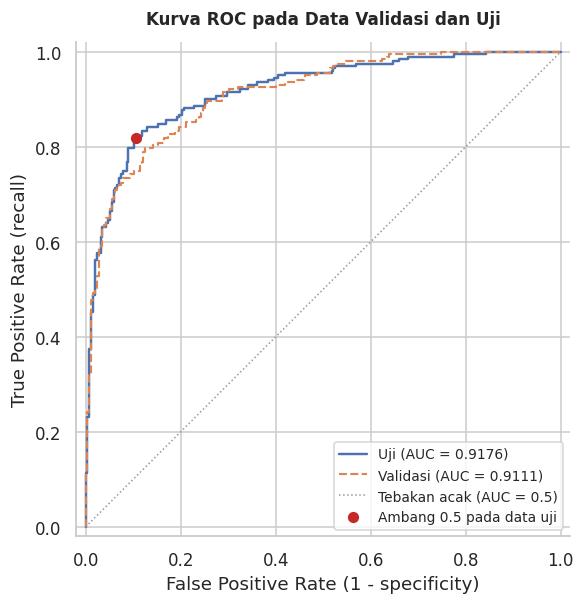
Overall the model performs solidly but not perfectly — which is exactly why SpotCheck presents its output as a supportive read rather than a diagnosis.
Inference & export
⌄For a new photo the model applies exactly the same preparation as training — RGB conversion, portrait-to-landscape rotation, letterbox onto the 336×224 canvas, divide by 255 — then outputs one probability. A score of 0.5 or above is read as dermatophytosis; below that, dermatitis. The confidence shown is simply how far that score sits from the 0.5 line.
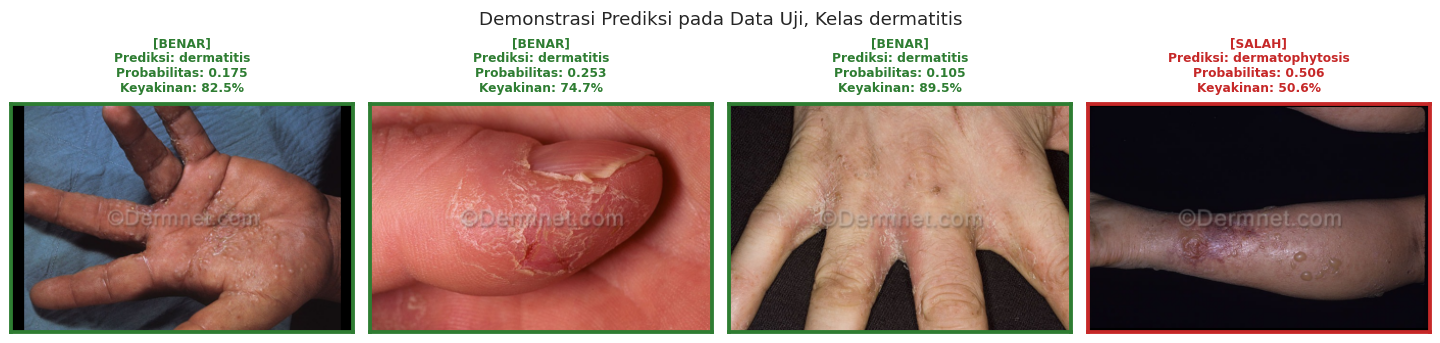
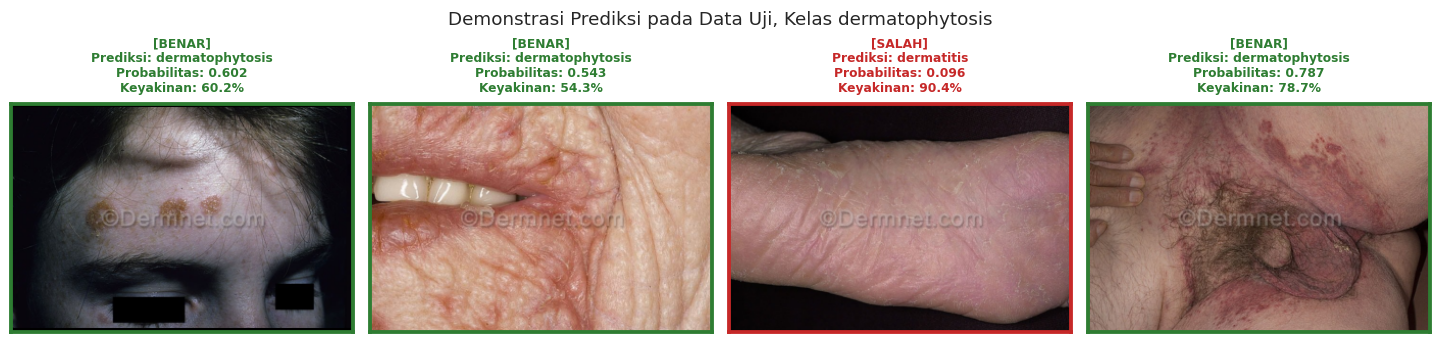
The final model was exported to the .keras format — an 8.68 MB file — alongside a small JSON config recording the class order, threshold and preprocessing steps, so this web app reproduces the training pipeline exactly rather than from memory.
The model has no way to say "neither". It is a closed-set binary classifier: one sigmoid output, one threshold, two possible answers. Nothing in the pipeline checks whether an image belongs to either family in the first place — there is no out-of-distribution detector and no rejection class.
So a photo of healthy skin, a different skin condition, or something that isn't skin at all still comes back as dermatitis or dermatophytosis, and the confidence figure can be high even then. That number only ever means which of the two the image resembles more — never that the image is one of the two. Treat any result on an out-of-scope photo as meaningless rather than as a finding.